Saturday (Feb 4)
Wednesday, February 15, 2012
In Vino Veritas
Saturday (Feb 4)
"Rains Down in Africa" (or at least Jeffreys Bay)
Tuesday, January 31, 2012
"Simba 1, come in"

Blogging from Earth lodge in Sabi Sabi on our last full day here. We have had an incredible time, and this has been a whole new safari experience for me. I'm used to going to Kruger, driving your own car, and hoping luck is on your side to see a cat. Here at Sabi Sabi, A trained guide along with a Shangan tracker drives you around in an open top land rover to find the big 5 and more. Did I mention the guide and tracker will leave the vehicle to track some animals(lion and leopard) on foot to find them, and all land rovers are in walkie-talkie communication? That way if one vehicle spots something, others can find it as well. Oh, and the vehicles go off road to get right next to the animal. Ben and I joked that it felt like Animal Kingdom's safari ride, and we were just waiting for the ranger to come on the radio to say "Simba 1, come in. There a some poachers in the reserve! Head east to help stop them."
Thursday, July 7, 2011
HAITI: Day 7 -- PIH and some R&R
We packed up said goodbye to our modest little home of the last week and headed back to Port au Prince for a day of rest and relaxation with a stop at Partners in Health (PIH) along the way. When you enter the gates of PIH, you feel as if you’re entering a major compound. The driveway winds up to rows of concrete buildings. Some of the buildings serving as the hospital, others as homes for the patients, and other as community centers where women are taught skills to start local businesses. One of the community healthcare workers started us off on a walking tour of the outside of the compound.
At one point, we ran into a little boy who called himself Anyo. As he saw me, he asked me “Kreole? English?,” and I tried to explain to him that I only spoke a little Kreole…could he speak English? He told me yes and then proceeded to tell me “My name is Anyo” in perfect English. He was so friendly and outgoing, and the first child I met that could speak any English.
We enjoyed our time at the hotel, taking advantage of the pool and everything else the hotel had to offer—a celebratory ending of our trip to Haiti.
Overall, I enjoyed my trip to Haiti. It was fulfilling, frustrating, heart breaking, heartwarming, educational, and incredibly fun. The country has countless problems, but the people are resilient, and that gives me hope.
Wednesday, July 6, 2011
HAITI: Day 5 & 6 --working in clinics
Wednesday, June 29, 2011
HAITI: Day 4 -- Clinic near Marmot
As we set out for our second day of clinic, we stopped by the newly finished Marmot Maternity Center. Staff includes 3 ambulatory nurses and support staff. They are still looking for a doctor and a midwife, but Marie said they were currently talking to a midwife who would most likely fill the position. The clinic had 2 NICU beds, and observation room, and a maternity ward. It's definitely progress and will fill a huge need in the community.
We then continued on to our clinic site. Rough roads again, but not quite as bad as the previous day. Looking out my window and seeing all the little kids -- on horses, carrying water, waving at the passing car-- I felt hopeless. Haiti/Medishare is making progress -- the maternity clinic and the nutrition factory, but the way these happy, outgoing kids were living just made my heart ache.
I spent the morning in the pediatrics clinic with Susan. It was so hot (no air flow) that I was trying my best just to not sweat on our patients. We even had a few students who were sweating so much that they soaked through their scrubs. Our patients had a lot of non specific abdominal pain (most likely due to worms) and some upper respiratory infections. We also had a girl with rectal prolapse. Apparently she had an operation for it a few months ago, but it had reoccurred. The mom was very worried about it, and said every time it happened, she had to push it back in. There was very little we could do for her, so we just suggested she returns to the surgeons who did the operation.
In the afternoon, I worked on pediatric triage with a local nurse. This included height and weight measurements, temperature, and arm circumference. The local nurse was invaluable -- she could communicate with the mothers and children to get the most accurate weight and height measurements. Triage also provided some down time to just play with the adorable little kids. There was one 3 year old wearing her mom's wide brimmed hat who came over and decided to play peek-a-boo with me --so adorable :)
It turns out we got done with the pediatric patients before the adults, so I moved outside to try and triage the adults since we probably wouldn't have time to see them all. I started off taking vital signs and sent in patients with extremely high blood pressures. We then realized we had time to see even fewer patients than we though, so I started going around with a translator to get the patient's chief complaint. While we were walking around, Woon Cho came out and spotted a sickly looking man and looked at his health record where it stated he might have HIV. Woon Cho immediately took him inside. One of our doctors, David, works at the AIDS clinic in Atlanta, so we took the patient to see him. Since we have no HIV medication, David wanted our patient to go to the nearest hospital to receive treatment. After finding out the man could not afford transportation to the nearest hospital, David collected money and gave it to the man.
While I was triaging, there was another woman complaining of an eye problem. I unfortunately had to tell her that we had no eye medication we could give her. On the ride home, we discussed how it would be really helpful to bring an opthalmologist on the next trip since so many of our patients had eye complaints related to working out in the bright sun without any eye protection.
On the second day of clinic there were quite a few interesting cases in the adult clinic where we could either provide treatment or refer the patients to a center where they could receive care. Overall, it was starting to feel like were having some kind of impact.
HAITI: Day 3-- Clinic in the Mountains
06-21-11
Before heading out for our first day of clinic, Marie offered to give us a tour of the Akamil nutrition factory and the new Medishare compound.
Akamil is a legume and micronutrient enriched millet. The main goal of the Akamil plant is to improve malnutrition in the area. The plant also aims to provide microbusiness to the community through women precooking the millet before selling it as well as providing jobs as factory workers for local community members. Right now, the plant is funded through outside grants, but the goal is for it to be self-sustainable. One of the ways they hope to accomplish this is through mass production and sale in larger grocery stores in Port Au Prince. Other parts of the plant are used for chlorine packet production (for treatment of water) and water container buckets. These buckets have a spicket and no handle, so they can only be used as the family’s water container.
The new medishare compound is very impressive and should be completed with in the next year. Not only will it include updated living facilities, it will also include a conference area where Medishare can host potential donors and collaborators.
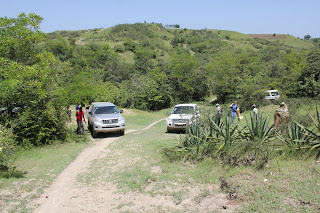
We then headed out to clinic in an extremely remote part of Haiti. We had rented 4WD vehicles for our trip, and the journey to the clinic site made me see why – we traveled through rivers, across rocks, through mud, and up mountains. A little nerve racking, but our drivers were very skilled.
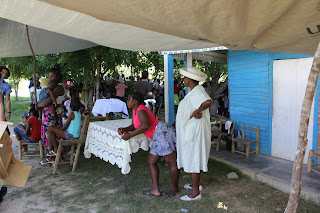
When we finally reached our clinic site, we found ourselves in a local church that was home to quite a few tarantulas. The presence of people scared them away soon enough and we started setting up our supplies. I spent the day in the pediatric clinic with Allison (the other pediatrician on our trip). Our first patient was a little girl with a severely burned arm. We debrided the wound and gave her mother some ointment and additional dressing to keep taking care of it. We also gave her some antibiotics to keep any skin infection away. The rest of the cases mostly consisted of stomachaches, diarrhea, and upper respiratory infections. We had to leave a bit earlier than expected due to rain (and the extreme roads that would become worse in this weather).
I left clinic feeling sad for these people in these destitute conditions and thinking, “Are we really making a difference?” Sure, we treated 1 acute case – the girl with the burns, but the other problems are just symptoms of larger societal problems – access to healthcare, access to clean water, access to education, access to foods with proper nutrition, and access to proper housing.